Attic mold removal in Greensboro runs $1,500–$5,000 for most homes, including HEPA cleaning of the sheathing and the air sealing that stops recurrence. The cause is winter condensation: warm moist indoor air leaking into a cold attic and condensing on roof sheathing, not a roof leak.
Here's the mechanism, why it's a Piedmont problem specifically, and what a lasting fix includes.
Winter condensation, explained
Your house generates a surprising amount of moisture. Showers, cooking, laundry, dishwashing, houseplants, and the people living there all put water vapor into the indoor air. In summer the air conditioning removes much of it. In winter, nothing does, and warm air rises.
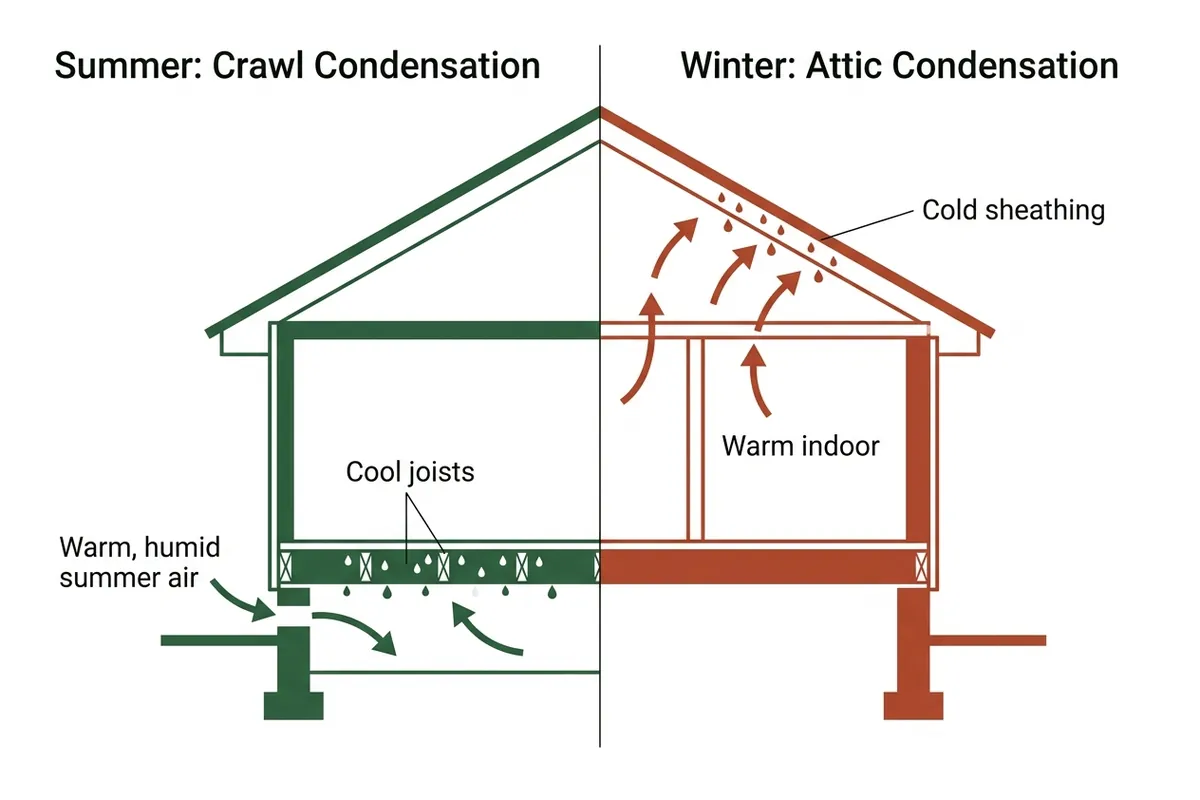
That warm, moisture-laden air leaks upward through every gap in the ceiling plane: the attic hatch, recessed light housings, bath fan and plumbing penetrations, wiring holes, and the gaps where interior walls meet the ceiling. Once in the attic it meets roof sheathing that on a January night is at or below freezing.
The moisture condenses on the underside of that plywood. On the coldest mornings it can form frost on the sheathing and on nail tips protruding through it. Then the sun hits the roof, the frost melts, and the plywood absorbs it. Repeat that cycle through a Piedmont winter and you get the dark streaking that follows the framing bays: visible in spring, when someone goes up for storage boxes.
Why this is a Piedmont problem
Markets an hour and a half southeast barely have this. Coastal winters aren't cold enough for long enough to drive it, so their attic problems are summer humidity problems instead. Markets far north have it, but their building codes and construction practice have long assumed it.
The Piedmont sits in between: winters cold enough to condense, in a housing stock that was largely built without much attention to air sealing the ceiling plane. That combination is why the attic belongs in every inspection here rather than as an add-on, and why plenty of Triad homeowners discover they have had this for years.
What the work includes
- HEPA vacuuming and abrasive cleaning of affected sheathing and framing: removal, not treatment
- Containment at the access point, so what comes down doesn't come down into the house
- Insulation removal where it's been repeatedly wetted or contaminated
- Air sealing the ceiling plane: hatch gasketed, recessed lights sealed or replaced with airtight fixtures, penetrations foamed. This is the actual fix; everything else is cleanup.
- Bath and dryer duct correction: terminating outside the building, verified, and insulated where they cross the attic
- Ventilation balance: soffit intake checked against exhaust rather than assumed, and blocked intake cleared
Air sealing beats adding vents
The instinct is to add roof vents, and it frequently backfires. Attic ventilation is a balanced system: air enters low at the soffit and leaves high. Add exhaust without matching intake (or leave soffit vents blocked by insulation, which is very common) and the attic can start drawing makeup air from the conditioned house below, pulling more indoor moisture up with it. That worsens the exact problem you're trying to solve.
Sealing the ceiling plane addresses the cause directly: less indoor air gets up there, so less moisture is available to condense. It's usually cheaper than new roof vents, and it lowers your heating bill as a side effect.
Indoor humidity in winter is part of the fix
The other half is reducing what's available to leak. In cold months, indoor relative humidity around 30 to 40 percent is the usual guidance for this climate: enough for comfort, low enough that a small amount of air leakage doesn't deposit much water upstairs. Running a humidifier hard through a Piedmont winter in a house with an unsealed ceiling plane is, in effect, watering your attic.
Why does an attic grow mould in winter here?
It is the reverse of what people expect. The signs are seasonal: dark staining on the underside of the roof sheathing, frost on nail points in January, insulation matted down in one bay, a bathroom that stays steamy long after a shower.
| Cause | What it looks like in the attic | The fix that actually works |
|---|---|---|
| Bath fan into the attic | Staining concentrated above one bathroom | Duct it through the roof or wall. Never into the space |
| Air leaks from below | Staining worst near the access hatch and light boxes | Air sealing the ceiling plane, before insulation is touched |
| Blocked soffit vents | Even staining across a whole slope | Clear the soffits and restore the baffles |
| Indoor humidity too high | Widespread light staining, worse in a wet winter | Control the moisture source in the house; venting cannot outrun it |
The Piedmont runs two separate condensation seasons: humid summer air on cool crawl space framing, and warm indoor air on cold attic sheathing in winter. An attic problem here is a winter problem, and adding vents to a leaky ceiling usually pulls up more moist air rather than less.
Attic questions, straight answers
What does attic mold removal cost?
Most Piedmont attic jobs run $1,500 to $5,000, covering HEPA cleaning of the sheathing, removal of contaminated insulation, and the air sealing and ventilation corrections that stop it recurring. Cost tracks square footage affected and how much insulation has to come out and be replaced.
Why does my attic have mold when there's no roof leak?
Because the water is coming from inside the house. Warm moist indoor air leaks upward through the attic hatch, recessed lights, and duct and wiring penetrations, then meets sheathing near freezing and condenses on the underside. No leak required: the house supplies the water and winter supplies the cold surface.
We noticed it in spring. Did it happen then?
Usually it happened over the winter and became visible in spring. Condensation and frost accumulate through the cold months, then melt and darken the plywood as temperatures rise, which is when people go up for storage and find it. The staining reflects a season that's already over, not an active problem that day.
Does sheathing have to be replaced?
Usually not. Plywood and OSB with surface growth typically respond to HEPA vacuuming and abrasive cleaning. Replacement is warranted where material has been wet long enough to delaminate or lose structural integrity. A condition a good specialist photographs and shows you rather than asserting it from the hatch. Be skeptical of a bid that opens with full replacement.
Will adding roof vents fix it?
Sometimes, and sometimes it makes things worse. Ventilation is a balanced system of soffit intake and high exhaust; adding exhaust without matching intake can pull more conditioned air out of the house and up into the attic, bringing more moisture with it. Air sealing the ceiling plane usually matters more than adding vents.
Get a Greensboro mold inspection
Tell us what you’re seeing: a musty smell near the floor, dark streaks on attic sheathing, staining on a wall, water standing against the foundation, and we'll pass your request to one independent local specialist, who can set up an inspection. A local specialist who works in Greensboro will call you back.