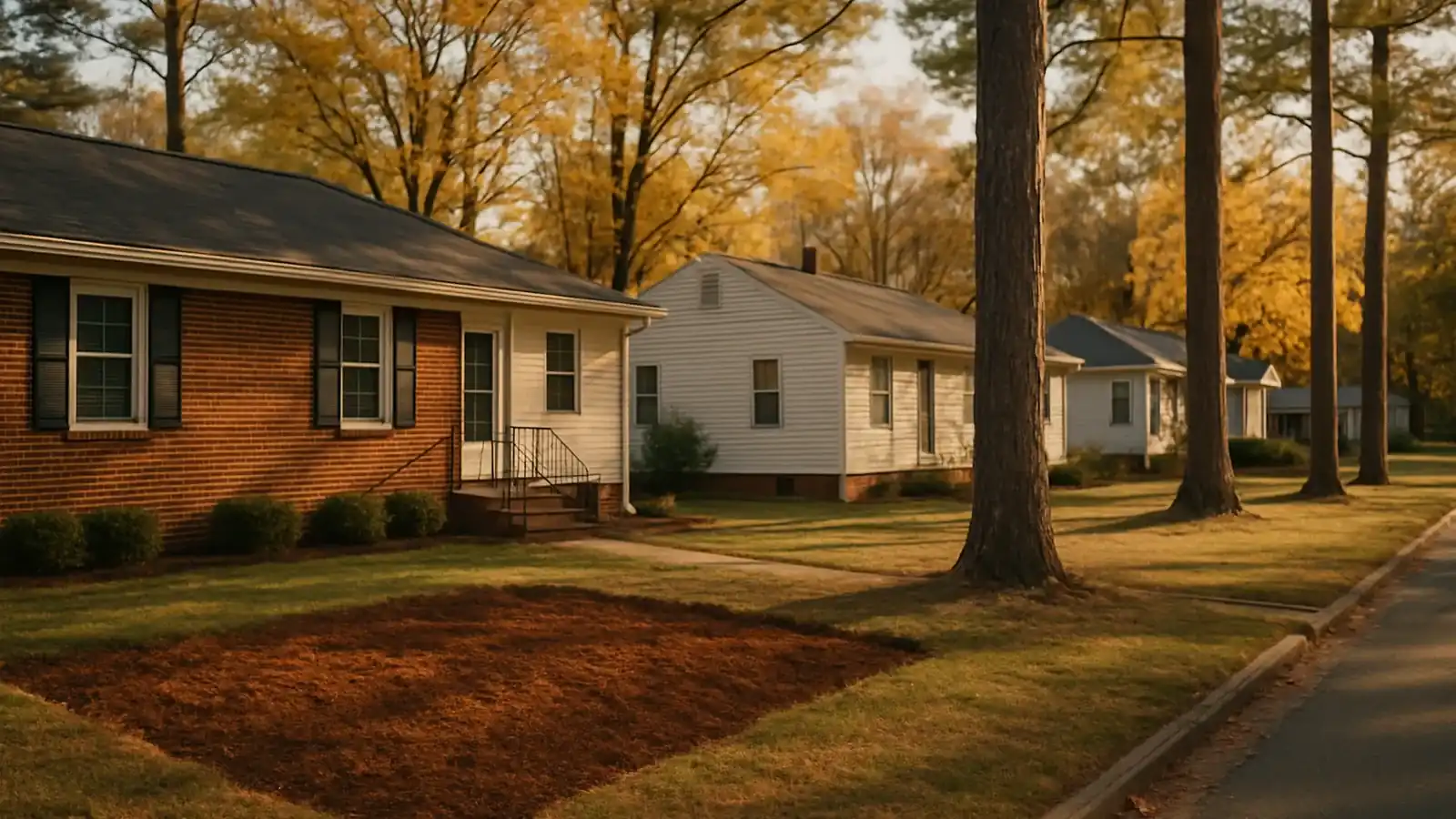
Greensboro Mold Removal Co. serves Greensboro plus High Point, Winston-Salem, Burlington, Kernersville, Jamestown, Summerfield, Oak Ridge, Gibsonville, and Archdale: requests for an inspection covering both crawl space and attic from all of them, and it is worth asking whether travel is priced as its own line.
High PointWinston-SalemBurlingtonKernersvilleJamestownSummerfieldOak RidgeGibsonvilleArchdale
Every town we cover, and what changes there
Each of these has its own page, because the ground and the housing stock are not the same across the region. The short version:
High Point: Factory housing, built to one plan
High Point grew around furniture manufacturing, and a large share of its older housing was built for the people who worked in those plants: modest, well-framed homes on crawl spaces, put up in groups to a small number of repeating plans. Read what that means for a High Point property.
Winston-Salem: Three centuries of construction in one service area
Winston-Salem covers a broader range of building eras than anywhere else in the Triad, and each one carries a different moisture profile. Read what that means for a Winston-Salem property.
Burlington: Mill village housing repeats, and so does the failure
Burlington and the surrounding Alamance County communities grew on textiles, and the mill villages that housed those workers are still standing: compact, well-framed houses built in groups to a small number of plans, typically on crawl spaces, typically close together on modest lots. Read what that means for a Burlington property.
Kernersville: Newer construction shifts the diagnosis
Kernersville sits between Greensboro and Winston-Salem and has absorbed a great deal of the corridor's residential growth, which means its housing skews substantially newer than the mill towns around it. Read what that means for a Kernersville property.
Jamestown: An old core with an unusual amount of history for its size
Jamestown carries a genuinely old center for a town of its scale, with buildings well predating central heating and air conditioning. Read what that means for a Jamestown property.
Summerfield: Large houses have more attic to get wrong
Summerfield's housing runs toward larger homes on larger lots, and size introduces a complication that smaller houses don't have: complex rooflines create multiple attic spaces, some of them small, poorly connected, and easy to miss. Read what that means for a Summerfield property.
Oak Ridge: Farmhouses and what they were built to do
Oak Ridge retains a stock of older rural housing: farmhouses built well before central heating and air conditioning, usually on crawl spaces or piers, and typically added onto more than once across their lifetimes. Read what that means for an Oak Ridge property.
Gibsonville: A small town built close together
Gibsonville grew as a railroad town and its older core reflects that: compact housing on modest lots, buildings close to one another, and a downtown of older structures. Read what that means for a Gibsonville property.
Archdale: Mid-century ranches, and what they all have in common
Archdale's housing skews toward mid-century and later ranch construction on crawl spaces: solidly built, straightforward, and sharing a consistent set of moisture details that were normal for their era and are the problem now. Read what that means for an Archdale property.
Four housing stories across the Triad
The mill towns (High Point, Burlington, and the older parts of Greensboro) carry factory-era housing built in groups to repeating plans, which means whole streets share one set of weaknesses and one set of fixes. The historic districts, concentrated in Winston-Salem and small-town centers like Jamestown, need restraint: those assemblies were built to stay permeable, and sealing them can trap moisture rather than stopping it. Northwest Guilford acreage (Summerfield, Oak Ridge) brings larger houses with complicated rooflines, multiple attic pockets, and long exterior water paths across red clay. The growth corridors (Kernersville, Archdale, and newer subdivisions throughout) are tight modern construction where the mechanical system carries the entire moisture load.
That variation is why a template doesn't work here. Each page above reads its own community, and the inspection reads your specific building.
Three constants across all ten
Two seasons. Summer humidity condenses in crawl spaces; winter indoor moisture condenses in attics. A good inspection covers both ends of the house regardless of which one prompted the call.
Two humidity targets. Under about 60 percent relative humidity in summer keeps growth arrested. Around 30 to 40 percent in winter keeps you from supplying the attic. A hygrometer costs under $20 and tells you where you stand in either season.
Red clay. It doesn't percolate, so surface water stands against foundations and finds crawl spaces. Grading and downspout corrections do more here than most owners expect, and they should lead a good scope because they're the cheapest line available.
Somewhere between towns, or just outside this list? Ask: regional travel gets quoted honestly.
What it means when we say we cover a town
It means your request goes to a local specialist who serves that town, just as it does in Greensboro. Ask for moisture readings and photographs of what is growing, a written scope afterwards, and any travel charge quoted as its own line rather than buried inside the others. If travel is material, ask for that number before you agree to anything.
Damp problems get worse while they wait, so distance should never be a reason to put a visit off.
These 9 communities are the ones this guide knows well enough to describe the ground in advance. That is the honest boundary: not a radius drawn on a map, but the places whose housing and ground are well enough understood to write about.
Coverage questions
Is there an extra charge to come out to the outlying towns?
Ask for travel to be quoted as its own line when it applies, and to see it before agreeing to anything. It should not be folded into the price of the work, because a scope you cannot read is a scope you cannot compare against anyone else's.
My address is not on the list. Is it still covered?
Usually, and it is worth asking. The list is the area this guide knows well enough to describe in advance, not a hard boundary. Somewhere between two of these towns is almost always a yes.
Is the first visit free, everywhere on this list?
Many local specialists don't charge for the first visit, but it depends on the company. Ask when the specialist calls, before they come out. Ask for the moisture readings, photographs of what is growing, and the written findings, which are worth having whether or not you go ahead.
Why does the price differ between towns for the same job?
Because the ground does. Each town page above explains what changes locally, and the quote follows what the visit measures at your specific address rather than an average for the region.
Get a Greensboro mold inspection
Tell us what you’re seeing: a musty smell near the floor, dark streaks on attic sheathing, staining on a wall, water standing against the foundation, and we'll pass your request to one independent local specialist, who can set up an inspection. A local specialist who works in Greensboro will call you back.